Independent sourcing partner for Fiber Optic Equipment · factory quotations compared on the same wavelength, fiber, reach, host, and destination

FIBER OPTIC EQUIPMENT · US BUYERS

1g sfp module price

A 1g sfp module price is comparable after the wavelength, fiber plant, reach class, and host cage are written as one line. LinkScope Sourcing 02 works as an independent sourcing partner: the desk does not manufacture modules, hold cages, or speak for a carrier.

Gigabit Ethernet on an SFP cage is commonly a 1.25 Gbit/s line rate because 8b/10b coding turns a 1 Gbit/s payload into that baud. A 1.0625 Gbit/s Fibre Channel optic is a different electrical question. Write which rate the host expects before two factory figures share a column.

Request Factory Quotes Review inquiry options
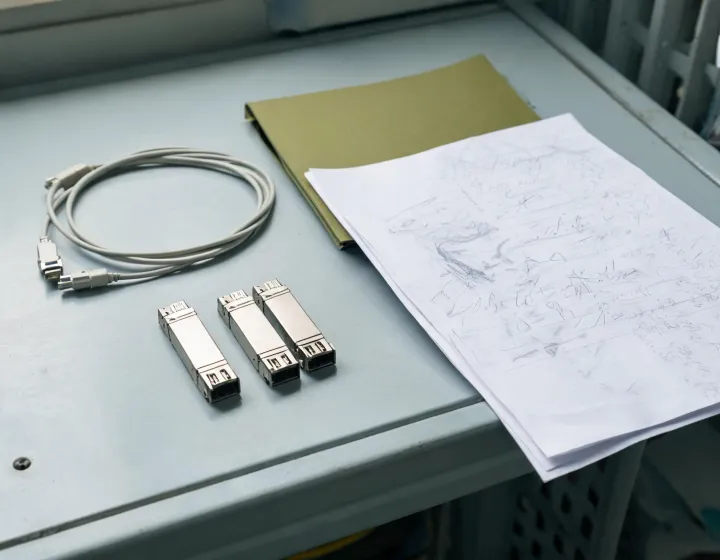
Unlabeled 1G SFP modules and a wavelength worksheet on a procurement bench

Evidence rows a buyer should close before ranking a unit figure

Each row is a question for the proposed supplier. A family catalog does not prove that the offered SFP matches the row on your bill of materials.

Wavelength

Separate 850 nm multimode, 1310 nm single-mode, and 1550 nm long-reach classes. An 850 nm part and a 1310 nm part can both be called 1G SFP and still fail in each other's plant.

Fiber and reach class

IEEE 802.3 1000BASE-SX is on the order of 550 m on 50/125 µm multimode and a shorter distance on 62.5/125 µm. 1000BASE-LX is specified around 5 km on standard single-mode. A factory sheet that prints 10 km at 1310 nm is a vendor reach class: ask which optical budget produced that number.

Optical budget

Ask for minimum transmit power and receiver sensitivity on the named model, then subtract. A worked check: if minimum launch is −9.5 dBm and sensitivity is −20 dBm, the module budget is 10.5 dB before connectors, splices, and margin. That arithmetic is a prompt, not a stocked part.

Diagnostics

SFF-8472 style monitoring, when implemented, reports temperature, supply voltage, laser bias, transmit power, and receive power. Ask which bytes the host can read. A screenshot from another platform is not that report.

Host code

State the switch or media converter, including the software release. An OEM EEPROM identity and a generic MSA identity are different offers. This desk has not seated the module in your cage.

A public ITU optical-fibre recommendation page checked on 2026-10-27 can suggest which questions to ask. It does not certify any module this desk forwards. Continue with the inquiry rows or the procurement note.

Who writes which part of the brief

A 1G SFP purchase splits across people who do not share one spreadsheet. The desk keeps their questions in separate columns so a commercial reply cannot hide a missing optical value.

Procurement manager

Owns quantity, currency, Incoterm, US destination, and whether the figure is per module or for the whole order. Two hundred pieces of one wavelength is not the same buy as forty pieces across five wavelengths. Freight, duties, and coding fees stay visible beside the module line.

Network architect

Owns fiber mode, connector, and the host. LC duplex is the usual SFP optical port. A bid that substitutes a pigtail, or that quotes a GBIC shell, leaves this comparison. Multimode at 850 nm answers a short floor run. It does not answer a campus single-mode span.

Quality reviewer

Asks for the current datasheet, the temperature window, and the test basis. A commercial window of 0 °C to 70 °C is not an industrial window of −40 °C to 85 °C. New-build and a pulled module stay in different columns until condition, DOM history if any, and warranty months are stated.

Power draw belongs with the host. Ask for maximum consumption in watts at the stated case temperature. A module under 1 W and a module near 1.5 W are different thermal loads in a dense cage. The RFQ desk is where those fields travel together.

Compatibility questions that move the quotation

Single-mode or multimode plant?

Single-mode fiber supports the longer 1310 nm and 1550 nm classes when the optic and the loss budget match. Multimode suits shorter data-hall and floor links with an 850 nm transceiver and the fiber grade the datasheet names. Mixing those rows makes the cheaper unit look like a saving when it cannot launch into the installed plant.

OEM-coded or a compatible EEPROM?

An OEM-coded module may sit closer to that vendor's support policy. A compatible code may widen the factory list when the exact host accepts it. A matching LC connector does not establish either outcome. Record the platform name and the software release, then ask the supplier which identity bytes they will write.

New cage module or a refurbished pull?

A refurbished unit can be a valid offer for a legacy host when the seller states condition, any available DOM hours, warranty months, and whether the EEPROM was rewritten. Do not average that unit figure with a new-build quote. Provenance is a document, not a photograph of a label.

What sits outside the module price?

LC jumpers, mode-conditioning cords where a multimode plant meets an LX optic, coding fees, firmware, freight, duties, and the destination. Those items move the landed total even when the wavelength matches. Return loss and connector mating-cycle limits belong on the jumper line, not on the module shell.

Paste the bill of materials into the brief

This form has no file upload. Copy the line items into the requirement field: interface, rate, wavelength, fiber, reach, connector, quantity, destination, and timing. Mark unknowns instead of guessing a default optic.

  1. One wavelength per line. Do not bundle 850 nm and 1310 nm.
  2. Name the host cage and software release.
  3. State currency and whether a target budget is per module or for the whole order.

The 80 km class has its own field list on the factory brief. CWDM channel plans sit on the application page.

Please enter your name.
Please enter a valid work email.
Please enter your company.
Describe the specification, quantity, destination, and delivery timing.

Submitting lets the desk review the brief and contact factories. Read the Privacy Policy. Stock, price, compatibility, and compliance stay unconfirmed until a named supplier answers the exact module.