Independent sourcing partner for Fiber Optic Equipment · factory quotations compared on the same wavelength, fiber, reach, host, and destination

LONG-REACH CLASS · FACTORY PACKET

sfp module 80km factory

An sfp module 80km factory quotation is a link-budget class, not a promise that 80 km of your fiber will close. LinkScope Sourcing 02 asks factories to answer the same optical rows. The desk does not own a laser line and does not certify a span.

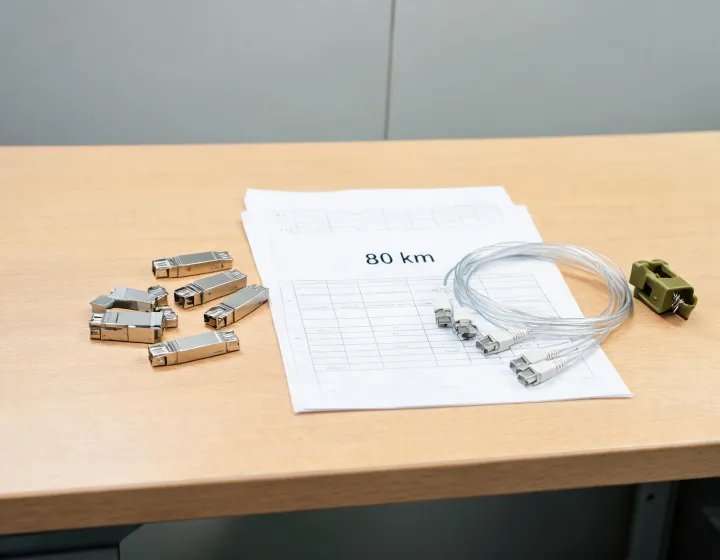
Unlabeled long-reach SFP modules beside a span-loss worksheet
  • 1550 nm class is the usual long-reach question
  • Fiber loss is calculated, not copied from the label
  • Dispersion tolerance is a separate cell
  • Mux and jumper loss stay outside the module

Interface rows the factory must fill

At about 0.22 dB/km, 80 km of G.652 fiber is about 17.6 dB before connectors, splices, and margin. Chromatic dispersion near 17 ps/nm/km times 80 km is about 1360 ps/nm. Those two numbers are buyer arithmetic. They are not a datasheet for a module this desk has not seen.

Launch and sensitivity

Ask for minimum transmit power and receiver sensitivity, often an APD receiver on this reach class, plus the overload point. A budget of 23 dB does not survive 17.6 dB of fiber plus 2 dB of connectors and 3 dB of margin unless the datasheet actually shows that margin.

Wavelength and connector

Confirm 1550 nm rather than a 1310 nm 10 km part that was relabeled. LC duplex is the usual cage exit. State polish if the plant specification names it. Return loss belongs on any jumper the quote includes.

Temperature and power

A roadside cabinet at −40 °C to 85 °C is an industrial window. A 0 °C to 70 °C commercial part is a different offer. Ask for maximum power in watts, because a long-reach laser can run hotter than a short-reach 850 nm part in the same cage.

What the price excludes

Dispersion compensation, attenuation pads, LC jumpers, EEPROM coding, freight, duties, and commissioning. Write each exclusion on its own line. A lower module figure that omits a compensating module is not the lower landed scope.

Questions that keep two factory replies on one basis

Which rate is on the electrical side?

State 1.25 Gbit/s Gigabit Ethernet or the rate the host actually clocks. An 80 km label on a 10 Gbit/s SFP+ is a different family and must not share this comparison. The host cage mechanical outline can look similar while the electrical interface does not.

Is 80 km the fiber length or the datasheet class?

Vendors print a class. Your OTDR trace is the length plus splice loss. Ask the supplier which fiber attenuation, in dB/km, and which connector count their class assumes. If your span is 72 km with four patches, recompute instead of trusting the badge.

Who supplies the dispersion number?

Request the module dispersion tolerance in ps/nm and whether a compensating module is excluded. A family brochure range is not the tolerance of the model they will ship. Bind the number to the manufacturer and the exact part code.

How should a target budget be written?

Name the currency and whether the amount is per module or for the whole order. A high-end, mid-range, budget, or undecided supplier preference is a buyer note. It is not a verified factory grade, and you do not need a live quotation before you send the brief.

Short-reach 1G rows stay on the inquiry list. CWDM grids are a different factory question on the application page.

Send the 80 km packet

Include wavelength, fiber type, measured or estimated span loss, host platform, quantity, US destination, and requested timing. The desk will not invent a loss figure you left blank.

Please enter your name.
Please enter a valid work email.
Please enter your company.
Describe the specification, quantity, destination, and delivery timing.

Submitting lets the desk review the brief and contact factories. Read the Privacy Policy. Stock, price, compatibility, and compliance stay unconfirmed until a named supplier answers the exact module.